

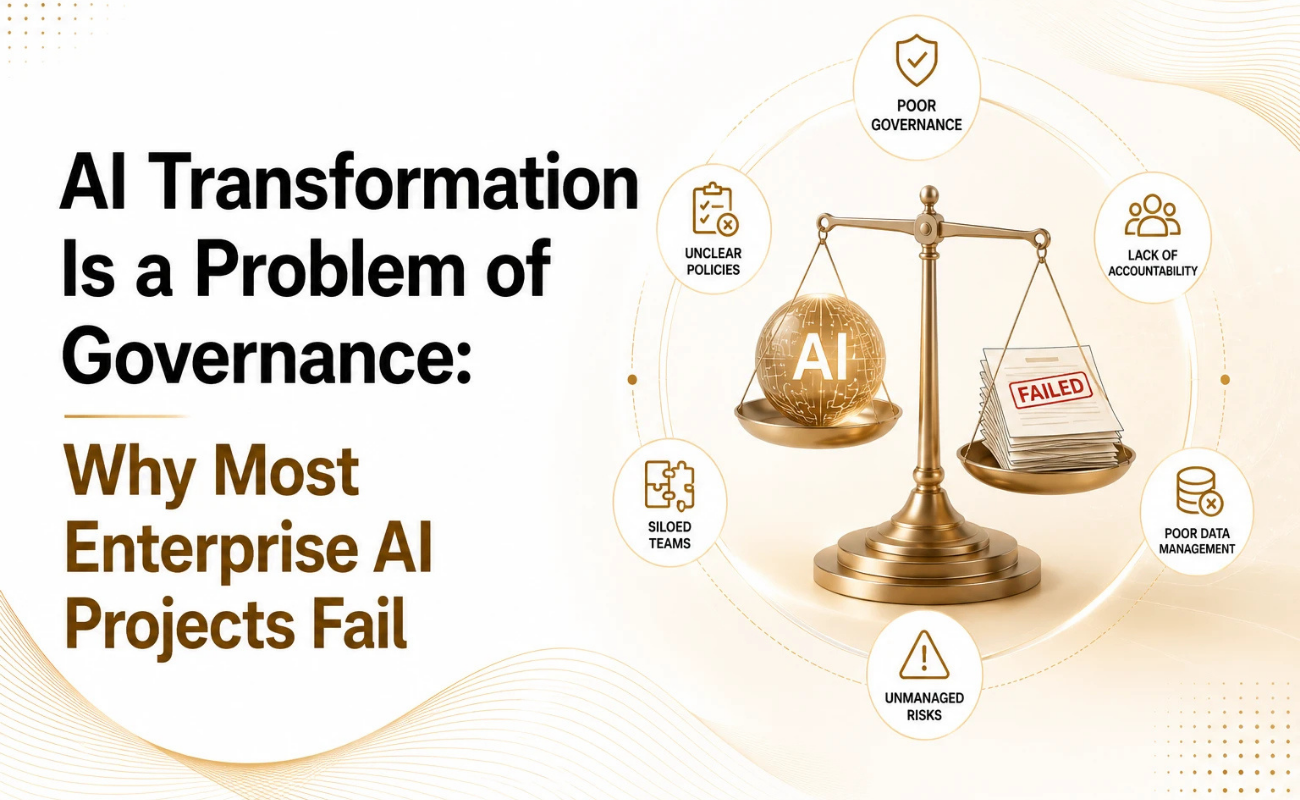
Most companies are already running AI in production. The real headache? Nobody knows who’s on the hook when the AI screws up. In 2026, the challenge isn’t about building smarter models or throwing more computing power at things. It’s about who has the authority, who owns the decisions, and who reports to whom. Boards sign off on budgets, IT teams push the projects live, and somewhere in between, accountability disappears. That gap — not the algorithms — is what kills most AI rollouts.
Why This Is a Governance Problem, Not a Technology One
Three stats paint the picture:

72% of enterprises had AI running in production (McKinsey, 2024)
Only 9% said their AI governance was actually mature
42% of companies abandoned most of their AI initiatives in 2025, up from 17% the year before (S&P Global, 2025)
MIT’s GenAI Divide report tracked $30–40 billion in enterprise AI spending and found that only 5% of generative AI projects moved the needle on actual profit and loss.
The pattern is clear everywhere you look. Companies are deploying AI faster than they are figuring out how to govern it, and the bill for that mismatch is coming due in the form of scrapped projects.
Why Governance, Not Tech — Is the Real Bottleneck
Technology builds the system. Governance decides who gets to use it, who watches over it, and who takes the fall when it fails. When a loan model rejects someone unfairly, or a hiring tool screens out good candidates, the problem usually isn’t the math — it’s that nobody was clearly in charge.
Informatica’s 2025 CDO Insights survey backs this up: 43% of data leaders said data quality and readiness was their biggest blocker, another 43% pointed to technical maturity, and 35% flagged skills shortages. None of these is a model problem. They sit upstream, in territory that governance is supposed to cover.
The Governance Gap in 2026: By the Numbers
Board oversight hasn’t kept up with deployment speed:
62% of boards talk about AI regularly (NACD, 2025)
Only 27% have actually written AI governance into their committee charters
McKinsey’s numbers are even starker: just 28% of CEOs take direct responsibility for AI governance, and only 17% of boards formally own it.
What that means on the ground: AI systems shaping pricing, credit decisions, and hiring are running in roughly four out of five companies without a clear chain of accountability. The infrastructure conversation has moved ahead; the responsibility conversation hasn’t.
| Governance Indicator | 2025 Figure | Source |
| Boards with formal AI governance charters | 27% | NACD 2025 |
| CEOs directly accountable for AI governance | 28% | McKinsey State of AI |
| Organizations with mature autonomous agent governance | 20% | Deloitte 2026 |
| Organizations actively building governance programs | 77% | IAPP AI Governance Report 2025 |
| Organizations with formally defined AI oversight roles | 28% | IAPP 2024 |
Read Also: Usanewscity .com: Everything You Need to Know About the Trending Website
Agentic AI Is Making the Gap Worse
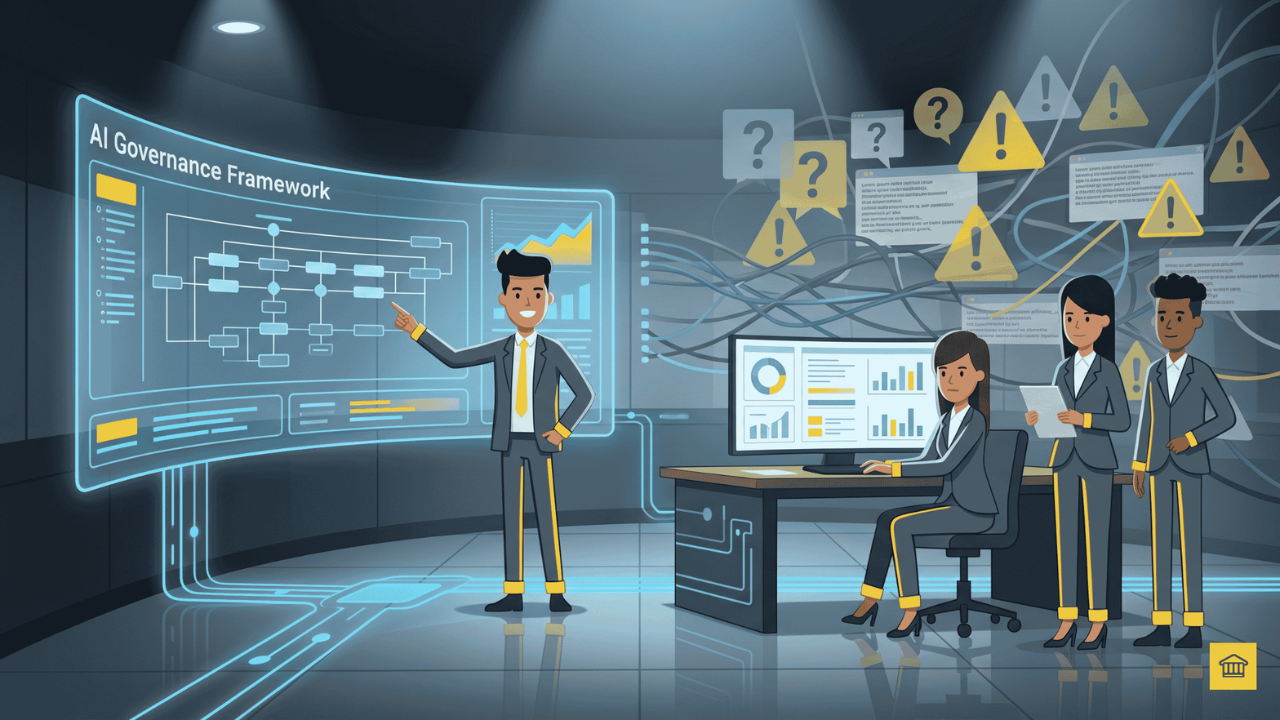
Deloitte’s 2026 State of AI survey (3,235 senior leaders) found only 1 in 5 organizations has a mature governance model for autonomous AI agents. These agents take action on their own — so when they make a mistake, it compounds across multiple steps before a human even notices. Errors here don’t behave like typical software bugs waiting to be reported; they spread quietly, like corrupted cache data building up until something visibly breaks.
How AI Governance Differs From Regular IT Governance
Models Drift — IT Systems Don’t
A standard system behaves the same way in March as it does in October. AI models retrain, absorb new data, and shift their outputs over time. Governance has to handle drift detection, retraining triggers, and rollback authority — none of which fit neatly into traditional IT change-management processes.
Data Readiness Is the Silent Killer
Gartner’s Q3 2024 survey of 248 data management leaders found 63% of organizations either lack AI-ready data practices or aren’t sure whether they have them. Gartner predicted in February 2025 that 60% of AI projects will be abandoned through 2026 because of data readiness alone. A model is only as good as the data it’s fed — same way a server benchmark only reflects the workload you throw at it. Bad data in means bad results out, and that only gets worse as you scale up.
Speed-to-Market Pressure Squeezes Out Oversight
Pacific AI’s 2025 survey of 351 organizations found 49–54% cited speed-to-market as the top barrier to governance, depending on company size. Late-stage AI deal sizes jumped from $48 million on average in 2023 to $327 million in 2024, raising investor expectations for fast delivery. Governance gets squeezed in the rush.
What Solid AI Governance Looks Like in 2026
Pacific AI’s data shows monitoring AI in production is the most common control (48%), followed by risk evaluation (45%). Useful, but neither covers who owns the harm or how to escalate when things go wrong. A working framework in 2026 needs four things, ideally documented before deployment rather than after something goes sideways:

- A named accountable executive for each high-impact AI system, with sign-off authority on both
- launch and retirement
- Defined error thresholds and pre-agreed escalation routes when the model crosses them
- A data lineage record covering training inputs, retraining schedule, and drift checks
- Regulatory mapping against the EU AI Act, Colorado AI Act, and California ADS rules (effective October 1, 2025)
Stanford HAI’s 2025 AI Index recorded a 21.3% year-on-year jump in legislative AI mentions across 75 countries, with US federal agencies issuing roughly twice as many AI regulations in 2024 as in 2023. Companies that built governance early are absorbing this smoothly; those that didn’t are now scrambling to retrofit under regulatory deadline pressure.
Final Word
AI isn’t failing because the technology isn’t there — it’s failing because nobody clearly owns the decisions it makes. In 2026, the companies getting ahead aren’t the ones with the fanciest models; they’re the ones who figured out who’s accountable, who watches the outputs, and who steps in when things go sideways. Governance isn’t exciting, but it’s the difference between AI projects that ship and AI projects that get shelved. If your board hasn’t written AI oversight into its charter yet, that’s probably where to start.
Read More: Cashstark com: Easy Guide to Earn Free Recharge and Rewards
